
Many intended parents who build their family through gestational surrogacy also need a donor - a donor egg, donor sperm, or occasionally both. You find donors in four main ways: through your fertility clinic, through an egg donation agency, through a licensed egg or sperm bank, or through someone you already know. Whichever route you take, every donor is screened under U.S. Food and Drug Administration rules and, in most reputable programs, under the additional medical, genetic, and psychological guidelines set by the American Society for Reproductive Medicine (ASRM). The decisions that shape your choice come down to four things: the donor's health and screening results, whether the donor is known to you or nonidentified (historically "anonymous"), whether you use fresh or frozen eggs, and the legal agreements that confirm you - not the donor - as the parents.
At Worldwide Surrogacy Specialists, this decision rarely happens in isolation. It sits inside a larger surrogacy journey, and because our agency was founded and is led by a practicing reproductive attorney, the legal side of using a donor is built into how your journey is structured from the start.
Where do you find an egg or sperm donor?
There are four common paths, and intended parents often consider more than one before deciding.
Through a fertility clinic. Many IVF clinics either keep their own donor programs or work with specific banks and can guide you directly to available donors. In a typical surrogacy journey, choosing a donor and creating embryos happens with your fertility specialist before an embryo is ever transferred to your surrogate. If you have not selected a clinic yet, that is one of the first steps in the intended-parent process.
Through an egg donation agency. There are a number of very reputable egg donation agencies where you can access a database of available egg donors. At Worldwide Surrogacy Specialists, we have very good connections and references for our intended parents to be successful and satisfied in the search for their egg donor.
Through a licensed egg or sperm bank. Banks maintain profiles of donors who have already completed screening, which can shorten timelines. Frozen donor eggs and quarantined donor sperm are usually sourced this way.
Through someone you know. Some intended parents ask a friend or family member to be a known donor. This path carries its own medical, emotional, and legal considerations, covered in the sections below.
A word of caution that has not changed across the years we have written about this: do not choose a donor on cost alone, and be realistic that physical characteristics on a profile tell you very little about the child you will raise. There is no such thing as a perfect donor. The screening results and the legal protections matter far more than a photograph.
How are egg and sperm donors screened?
Donor screening runs on two layers: what the FDA requires by law, and what ASRM recommends on top of it.
The FDA layer (required). Egg and sperm donors are regulated as donors of human cells and tissue under 21 CFR Part 1271. Before a donor's eggs or sperm can be used, a clinic or bank must make a formal donor-eligibility determination based on screening and laboratory testing. Under 21 CFR 1271.85, reproductive donors are tested for HIV-1 and HIV-2, hepatitis B, hepatitis C, and syphilis (*Treponema pallidum*); for HTLV-I and HTLV-II and cytomegalovirus (CMV); and for the genitourinary infections chlamydia (*Chlamydia trachomatis*) and gonorrhea (*Neisseria gonorrhoeae*). This is what people mean when they say donor sperm receives "federally mandated screening" - it applies to donor eggs as well.
The ASRM layer (recommended best practice). ASRM's 2024 guidance goes further than infectious-disease safety. It recommends that egg donors ideally be between 21 and 34 years old, and that if a donor is older her age be disclosed to you because it affects both pregnancy rates and genetic risk. It recommends expanded genetic carrier screening - pan-ethnic panels that include cystic fibrosis, spinal muscular atrophy, and hemoglobinopathies - rather than testing based on ethnicity alone. And it strongly recommends a psychological evaluation of every donor by a licensed mental health professional trained in third-party reproduction, along with counseling for recipients so that intended parents understand the implications of building a family with a donor.
This two-layer picture is why "minimal screening" is a real risk to watch for. If a donor arrangement skips the ASRM-recommended genetic and psychological steps, it is thinner than it looks, even when it meets the legal minimum. Confirm with your clinic exactly what screening a given donor has completed before you commit.
What is the difference between a known donor and an anonymous (nonidentified) donor?
A known - or, in ASRM's current term, "directed" - donor is someone whose identity you know: often a friend or relative, sometimes a donor you are matched with in an open arrangement. The appeal is familiarity and, for some families, an ongoing relationship. The risk is that a personal relationship does not guarantee your child will inherit any particular trait, and that the arrangement needs the same medical screening and legal contracts as any other, not less.
A nonidentified - historically "anonymous" - donor is one whose identity is not shared with you. Here is the most important update, and it corrects what many older articles still say: true, permanent anonymity can no longer be guaranteed. ASRM's 2024 guidance is explicit that anonymity is decreasing because of the prevalence of and access to direct-to-consumer DNA testing, and ASRM has shifted its own terminology away from "anonymous" for exactly this reason. A donor-conceived child, or the donor, can be identified later through a consumer DNA service - even if neither of them ever takes a test - because a relative's test can surface the connection. Choosing a nonidentified donor today is a choice about privacy expectations, not a guarantee of lifelong secrecy, and it is worth deciding as a family with that reality in view.
In every case - known or nonidentified - a written donation agreement matters. It sets out compensation, confidentiality expectations, and, critically, that the donor holds no parental rights or responsibilities. Informal, do-it-yourself arrangements skip exactly the protection you most need.
Do fresh or frozen donor eggs give you a better chance?
This is the question where the old rule of thumb has genuinely moved, so it is worth stating carefully.
Fresh donor eggs still show a modest edge in live-birth rate per transfer in national U.S. data. A 2024 analysis of the CDC's National ART Surveillance System - 135,085 donor-egg cycles, with detailed outcomes on 48,679 cycles from 2018 to 2020 - found live-birth rates per fresh-embryo transfer of 55.9% with fresh eggs versus 46.2% with frozen (Fertility and Sterility, 2024). But two things temper that gap. First, among babies actually born, the odds of a full-term, normal-birthweight singleton were essentially identical whether the eggs were fresh or frozen - the difference there was not statistically significant. Second, modern freezing (vitrification) has narrowed the gap considerably, and some clinic-level programs now report comparable results between fresh and frozen. Frozen eggs also offer more immediate availability and shorter timelines.
The honest summary: fresh eggs carry a small statistical advantage per transfer in the national data, frozen eggs win on availability and convenience, and once a healthy pregnancy is underway the baby's outcomes look the same either way. Your fertility clinic is the right party to weigh this against your specific situation.
Who are the legal parents when you use a donor?
For most intended parents, this is the part that matters most, and it is where a surrogacy journey with a donor is genuinely different from an ordinary IVF cycle. Using a donor adds another set of parental-rights questions on top of the surrogacy agreement itself, and the answers depend on your state.
In general, a donor who provides eggs or sperm through a physician-supervised clinical process or according to the law where the donation takes place, and under a proper written agreement, is not the legal parent of the resulting child - but the specific requirements, and how they interact with your surrogacy arrangement, vary meaningfully from state to state. This is precisely why Worldwide Surrogacy Specialists was built around an attorney from the start. Our founder, Victoria Ferrara, has practiced reproductive law since 1984 and argued the seminal parentage case *Raftopol v. Ramey* before the Connecticut Supreme Court, and that legal expertise shapes how the donor agreements, the surrogacy contract, and the parentage order are structured together - not reviewed after the fact, but built in from the beginning. At Worldwide Surrogacy Specialists, you will have a 24-7 surrogacy legal advisor every step of the way. You can read more about the legal landscape for surrogacy in the United States.
How does using a donor fit into a gestational surrogacy journey?
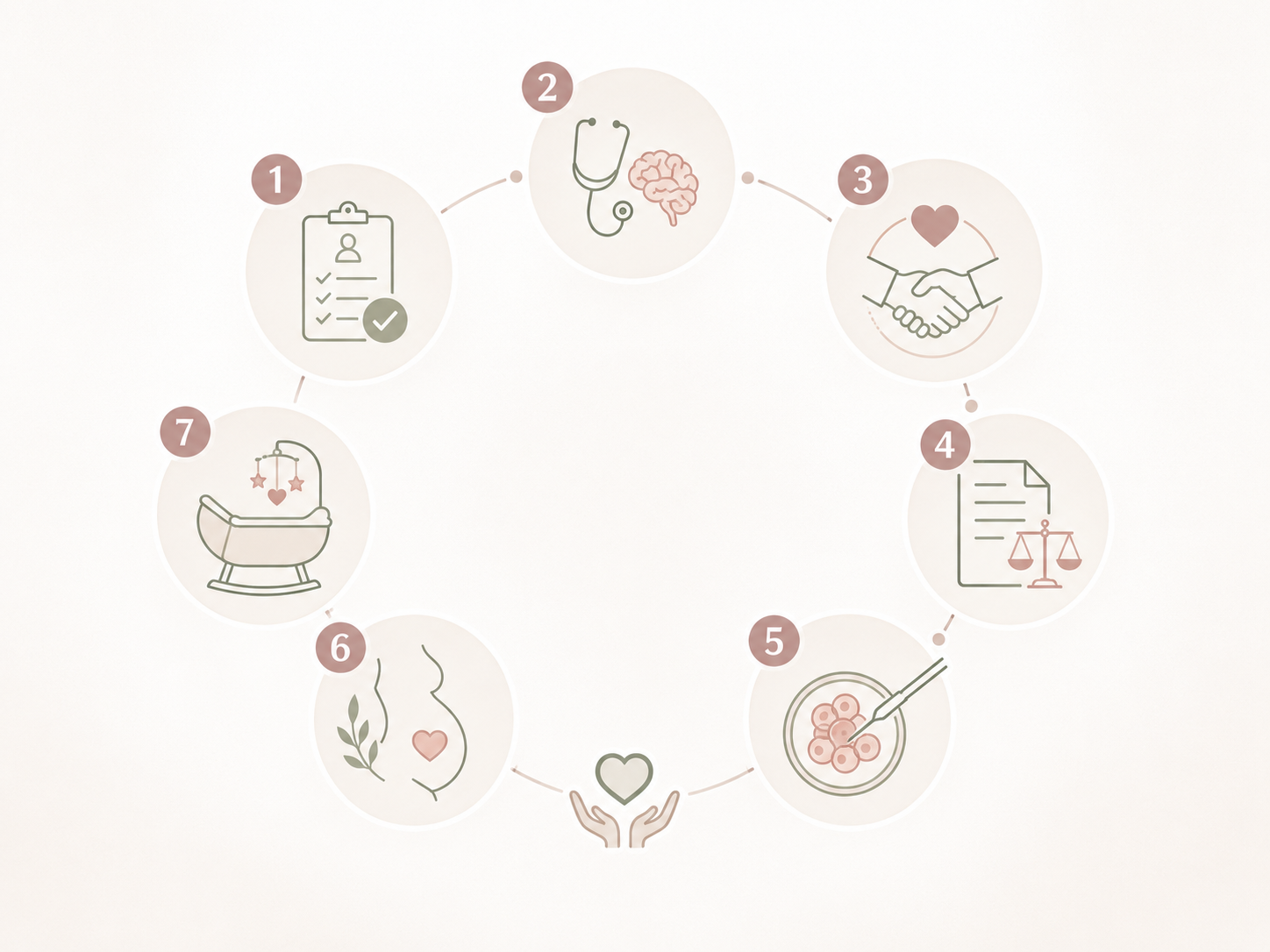
Using a donor is one stage inside a longer sequence, and it helps to see where it sits. In a typical journey, you select and enroll with your agency and fertility clinic; you choose an egg or sperm donor if you need one and work with your fertility specialist to create embryos; you are matched with a screened gestational surrogate; and an embryo is transferred to your surrogate, who carries the pregnancy. The donor step happens early, at the clinic, before matching leads to a transfer.
Throughout that sequence at WSS, your case manager stays with you from your first conversation through delivery - the same person, the same relationship - so the donor decision, the legal work, and the surrogacy match are coordinated rather than handed between departments. For the full sequence and what it involves, see the intended-parent process and getting started as an intended parent. For how the donor step and everything around it affects your budget, see our breakdown of surrogacy costs.
Choosing a donor is a significant, personal decision, and you should not have to make it without experienced people beside you. If you would like to talk it through, our team is here for that conversation.
Book a consultation with our team
Frequently asked questions
Do egg and sperm donors get tested for diseases?
Yes. Under FDA rules (21 CFR 1271.85), reproductive donors are tested for HIV, hepatitis B and C, syphilis, HTLV, CMV, chlamydia, and gonorrhea before their eggs or sperm can be used. For nonidentified (anonymous) sperm donors, the FDA also requires that specimens be quarantined and the donor retested at least six months after donation before the sperm is released.
Can I use a friend or family member as a donor?
Yes. A known (directed) donor is a common choice. It still requires the same medical and genetic screening as any donor and a written legal agreement establishing that the donor has no parental rights - do not treat a personal relationship as a substitute for either.
Is donor anonymity guaranteed?
No longer. ASRM's 2024 guidance states plainly that anonymity is decreasing because of widely available direct-to-consumer DNA testing, and that a donor or donor-conceived person can be identified later even without taking a test themselves. Choose a nonidentified donor understanding it as a privacy preference, not a lifelong guarantee.
Are frozen donor eggs as effective as fresh?
Close, and getting closer. National U.S. data still show a small live-birth advantage per transfer for fresh eggs, but the gap has narrowed with modern vitrification, and full-term healthy-birth outcomes among babies born are comparable. Frozen eggs offer more availability and shorter timelines.
Does the egg or sperm donor have any parental rights?
In general, a donor who donates through a proper clinical and legal process is not the child's legal parent, but the requirements vary by state, and this is exactly the kind of question an experienced reproductive attorney should handle as part of your journey.
---
Get the Latest Updates
Categories